
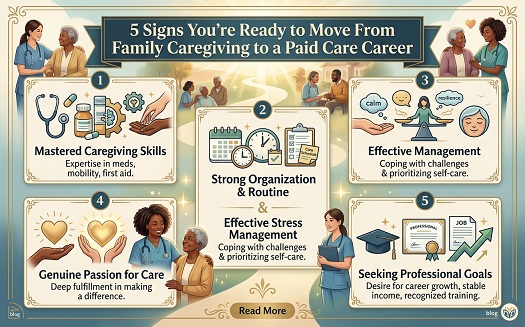
If you've spent months or years caring for a parent, partner, or another family member, you've already done something many trained professionals spend their first year on the job learning: you've cared for someone through illness, decline, confusion, fear, and vulnerable moments most people never see. What you might not have considered yet is that this experience — unpaid, often unrecognised, and rarely written down anywhere official — could be the foundation of an entire paid career.
Family caregivers frequently underestimate just how much genuine skill they've built. Communication under stress, patience with repetitive or difficult behaviours, hands-on personal care, medication routines, and the emotional steadiness to keep showing up on hard days — these are exactly the competencies professional caregiving employers look for. The question isn't whether your experience counts. It's whether you're ready to formalise it into something you can build a career on.
This guide walks through five clear signs that you're ready to make that move, and exactly what steps to take once you recognise them in yourself — including how an accredited online caregiver certification course can turn years of unpaid experience into a credential employers will actually recognise.
The Scale of Unpaid Caregiving — And Why So Few People Make the Leap
Before getting into the signs themselves, it's worth understanding the context you're part of. According to Carers UK, the UK's national charity for unpaid carers, millions of people across the country are currently caring for an older, disabled, or seriously ill family member or friend — often juggling this alongside paid work, raising children, or managing their own health.
Despite this enormous, largely invisible workforce of unpaid caregivers, remarkably few ever consider moving into paid caregiving work, even when their family caregiving role naturally winds down or changes. Part of this is simply not realising the pathway exists. Part of it is uncertainty about whether "just" caring for a relative really counts as relevant experience. And part of it is not knowing what formal steps — certification, DBS checks, references — actually stand between where you are now and a paid role.
If any of that uncertainty sounds familiar, the five signs below are designed to help you recognise where you already stand, and what's genuinely left to do.
Sign 1: People Keep Telling You That You're Good at This
Pay attention to the specific, recurring feedback you get from others — it's one of the clearest, most objective signals available to you.
Maybe it's a hospital nurse who comments that you clearly know how to handle your relative's confusion during a difficult appointment. Maybe it's other family members who've started asking you for advice on their own caregiving situations. Maybe it's your relative's GP or social worker noting how well you manage medication schedules or communicate changes in condition. Or maybe it's simply that friends who've tried to help out occasionally remark that they don't know how you do what you do every day.
This kind of feedback matters because it's coming from people observing your caregiving from the outside, without the emotional weight you carry internally about whether you're doing "enough" or doing it "right." When multiple people, across different contexts, independently comment on your competence, that's a meaningful data point — not just family loyalty or politeness.
Why this matters for a paid care career: Professional caregiving employers are, in the most practical sense, looking for exactly this kind of demonstrated competence. The challenge is that your family caregiving experience, however genuine, doesn't automatically translate into something an employer can verify from a CV alone. This is precisely the gap that formal certification closes — it takes the skill people have already noticed in you and turns it into a credential a hiring manager can act on. A Diploma in Caregiving in particular formalises exactly the kind of hands-on competence — personal care, communication, safety awareness — that the people around you have likely already recognised informally.
Sign 2: You're Hungry for the "Why" Behind What You Already Do Instinctively
Many family caregivers develop strong practical instincts without ever learning the underlying reasoning behind them. You might know that a certain approach calms your relative during a confused or agitated moment, without fully understanding the communication techniques specifically designed for dementia care that explain why it works. You might have developed your own system for safe transfers or mobility support through trial and error, without knowing the formal safety protocols professional carers are trained in.
If you find yourself curious about the "why" — wanting to understand the actual clinical or best-practice reasoning behind what you've been doing by instinct — that curiosity is a strong sign you're ready for formal training, not because your instincts have been wrong, but because you're ready to build genuine expertise on top of them.
This sign often shows up as small but telling behaviours: searching online for explanations of caregiving techniques, watching videos about dementia communication strategies, or wondering whether there's a "right way" to handle situations you've been managing on gut feeling alone. That intellectual curiosity, layered on top of real lived experience, is exactly the combination that makes for an excellent professional caregiver.
Why this matters for a paid care career: Formal training doesn't just validate what you already know intuitively — it fills in genuine gaps, corrects misconceptions you might not realise you have, and introduces techniques and protocols you'd have no way of discovering through family caregiving alone (infection control standards, safeguarding requirements, professional documentation practices). A structured online caregiver certification course is specifically built to answer the "why" behind caregiving practice, transforming instinct into informed, confident skill.
Sign 3: Your Caregiving Circumstances Are Changing — And You Want to Keep Caring for Others
This sign often arrives at an emotionally complex moment. Perhaps your relative's condition has stabilised and they now need less intensive support. Perhaps they've moved into a care facility, and your day-to-day caregiving role has changed or ended. Perhaps, difficult as it is to say plainly, your relative has passed away, and you're left with a caregiving skill set and no one left to use it on within your immediate family.
Whatever the specific circumstance, if you notice that you genuinely miss the caregiving itself — not simply the person you cared for, but the actual work of caring, the sense of purpose it gave you, the rhythm of a day built around helping someone — that's a significant, often surprising sign that caregiving isn't just something you did out of necessity. It's something you're genuinely suited to and drawn toward as ongoing work.
Many family caregivers experience a real identity gap once their caregiving role ends or changes substantially. After months or years of days structured entirely around another person's needs, that sudden absence can feel disorienting — and channeling that experience into paid caregiving work is one of the most common, successful ways former family caregivers navigate this transition.
Why this matters for a paid care career: If your caregiving circumstances have changed and you're finding yourself drawn back toward care work rather than away from it, this is a genuine, reliable signal — not simply grief or habit, but a real professional inclination worth taking seriously. It's also worth noting, gently, that if you're navigating grief alongside this transition, organisations like Carers UK offer support specifically for carers adjusting to life after a caring role ends, alongside the practical next step of exploring formal caregiving courses when you feel ready.
Sign 4: The Financial Reality of Unpaid Caregiving Is Starting to Weigh on You
This is one of the most practical, and often most decisive, signs — and it's worth addressing directly rather than avoiding it. Family caregiving is, for the vast majority of unpaid carers, financially unsustainable as a long-term arrangement. If you've had to reduce paid work hours, step away from a career entirely, or rely on limited support like Carer's Allowance to manage while caring for a relative, you've likely already felt the financial strain this creates.
According to the UK government's own information on Carer's Allowance, this benefit is specifically designed to provide some financial support to unpaid carers, but it's set at a modest weekly rate — nowhere near equivalent to a full-time salary — and comes with strict eligibility rules around how many hours you can work in paid employment alongside claiming it. For many family caregivers, this creates a genuine financial ceiling: caring unpaid limits your income, but the support available rarely closes that gap entirely.
If you've found yourself doing the maths on this — realising that the caregiving expertise you've built could translate into actual paid income, rather than remaining an unpaid, financially precarious role — that recognition is a strong, legitimate sign that it's time to formalise your skills into a career.
Why this matters for a paid care career: This is precisely where certification changes your financial trajectory. Moving from unpaid family caregiving to a paid caregiving role, supported by a recognised Certificate or Diploma in Caregiving, doesn't just replace lost income — it often improves your financial position more meaningfully than continuing in an unpaid role or attempting to re-enter an unrelated field from scratch, since you're building directly on skills and experience you already possess rather than starting entirely over.
Sign 5: You're Starting to Wonder Where You Could Take This — Specialisation, Progression, or a Long-Term Career
The final sign is more forward-looking than the others: you've started imagining yourself doing this work for other people, not just the relative you originally cared for, and you're curious about where a caregiving career could actually lead.
Maybe you've found yourself drawn specifically to dementia care, having developed real expertise navigating your own relative's cognitive decline. Maybe you're curious about end-of-life and palliative support, having walked closely alongside a loved one through their final months. Maybe you're simply wondering whether caregiving could become a stable, long-term profession — with room to grow into senior or specialised roles, rather than a single, one-off period of your life.
This forward-looking curiosity distinguishes readiness for a career from readiness for a single job. It suggests you're not just looking for any paid work, but specifically drawn to caregiving as a field worth investing in and building expertise within over time.
Why this matters for a paid care career: If this describes you, it's worth thinking beyond the minimum entry point. A comprehensive Diploma in Caregiving — covering dementia support, complex condition management, and end-of-life care — positions you not just for your first paid role, but for the specialised and senior positions you're already starting to imagine yourself in. Rather than starting with the bare minimum and upgrading later, this sign suggests you may be ready to invest in more comprehensive training from the outset.
What Family Caregiving Experience Actually Gives You — And What It Doesn't
It's worth being honest about both sides of this transition, since recognising the gaps is just as important as recognising your existing strengths.
What your family caregiving experience genuinely gives you:
- Real, hands-on experience with personal care, mobility support, and daily living assistance
- Emotional resilience and patience built through sustained, high-stakes caregiving over time
- Practical communication skills developed through real interactions with a vulnerable person
- A genuine, tested motivation for care work, rather than an abstract interest in the idea of it
- Direct exposure to the emotional realities of caregiving that no course alone can fully teach
What formal certification specifically adds on top of that experience:
- Documented, verifiable proof of your competence that an employer can actually act on
- Structured knowledge of safeguarding, professional boundaries, and legal responsibilities specific to paid care work
- Broader exposure to conditions and situations beyond what your specific family caregiving experience covered
- Professional standards and communication practices appropriate to working with clients who aren't your own relatives
- A credential that travels with you across different employers, rather than remaining tied to one specific caregiving relationship
Recognising both halves of this picture is exactly why formal certification and lived family caregiving experience work so well together — neither fully substitutes for the other, but combined, they position you far more strongly than either alone.
Common Doubts That Hold Family Caregivers Back — And Why They're Usually Wrong
Even after recognising several of the signs above, many family caregivers hesitate before actually making the move. It's worth naming these doubts directly, since most of them don't hold up well under closer examination.
"My experience doesn't really count because it wasn't a real job." This is one of the most common, and most inaccurate, beliefs family caregivers hold about themselves. Employers in the care sector regularly recognise family caregiving as genuine, relevant experience — particularly when it's substantial in duration and scope. The absence of a payslip doesn't erase the skill involved in managing someone's medication schedule, supporting their mobility safely, or navigating a difficult diagnosis alongside them.
"I'm too old to start a new career." Caregiving is one of the more age-inclusive professions available, with many successful carers entering the field in their 40s, 50s, and beyond — often precisely because life experience, patience, and emotional maturity are genuine assets in this line of work, not liabilities.
"I don't have any formal qualifications, so I probably can't get certified either." Most online caregiver certification courses require no prior qualifications at all — just a willingness to study the material and complete the assessments. This is specifically why these courses exist: to create a legitimate, accessible pathway into the profession for exactly the kind of experienced-but-uncertified candidate that family caregivers represent.
"What if I'm not as good with strangers as I was with my own family member?" This is a genuine, reasonable concern, but it's also one formal training directly addresses. Courses cover professional communication, working with unfamiliar clients, and maintaining appropriate boundaries — precisely the skills that differ most between family and professional caregiving, and precisely what a structured course is designed to teach.
"I don't know if I can handle caring for someone who isn't my own relative in the same way." Many former family caregivers describe finding this transition easier than expected, since some professional distance can actually reduce the emotional intensity that comes with caring for your own parent or partner, while your underlying skills and instincts remain just as relevant.
"It feels disloyal to move on to caring for other people." This is an understandable feeling, particularly if your caregiving role ended through bereavement, but it's worth reframing: continuing to use skills you developed while caring for someone you loved is often one of the most meaningful ways to honour that experience, not a betrayal of it.
If any of these doubts have been holding you back privately, it's worth recognising that they're common, well-understood hesitations — not evidence that you're genuinely unsuited to paid caregiving work.
What Actually Stands Between You and a Paid Caregiving Role
If you've recognised yourself in several of the signs above, here's a clear, practical picture of what the transition genuinely involves — deliberately demystified, since uncertainty about "what's actually required" is one of the biggest reasons capable people delay making this move.
A recognised certification. This is the step that formalises your experience into something employers can verify. A Beginner Certificate or full Diploma in Caregiving — completable online, at your own pace, typically within one to eight weeks depending on the level you choose — is usually the single most important step in this entire transition.
An Enhanced DBS check. Since paid caregiving involves direct contact with vulnerable adults, you'll need to undergo this background check, typically arranged and paid for by your employer once you're offered a role, so this isn't something you need to sort out independently in advance.
References. Even without prior paid care experience, references from people who've observed your family caregiving — a GP, social worker, or other professional involved in your relative's care — can meaningfully strengthen your application, alongside your training certificate.
A CV that translates your family caregiving experience clearly. This is a step many transitioning family caregivers underestimate. Framing your unpaid caregiving experience in clear, specific, professional language — the duration of your caregiving role, the specific tasks and responsibilities you managed, and any particular conditions or challenges you navigated — helps a hiring manager see your experience the way you already understand it internally.
A genuine understanding of the differences between family and professional caregiving. Professional caregiving involves working with people who aren't your relatives, maintaining professional boundaries, working within an employer's specific policies and procedures, and often managing multiple clients rather than one. A good online caregiver certification course explicitly addresses this shift, helping you translate your instincts as a family carer into the professional standards expected in paid roles.
How to Make the Transition: A Practical Step-by-Step Path
If you've recognised several of the signs covered in this guide, here's a clear sequence for turning that readiness into an actual paid caregiving role:
Step 1: Choose the right course level for your experience. If you've provided substantial hands-on family care over an extended period, a full Diploma in Caregiving may represent better value than starting with the most basic certificate, since it formalises and extends knowledge you likely already partially hold. If your family caregiving was more limited in scope, a beginner certificate is a reasonable, faster starting point.
Step 2: Complete your certification with genuine attention, not just for the credential itself. Even where course content overlaps with what you already know intuitively, engaging seriously with the material helps you identify gaps and correct any misconceptions your informal experience may have left you with.
Step 3: Request a reference letter if your training provider offers one. This, combined with any professional references from your relative's care team, helps offset a potentially thin formal employment history in care work specifically.
Step 4: Rewrite your CV to translate your caregiving experience professionally. Be specific: dates, duration, the particular conditions or needs you supported, and concrete tasks you managed — treat this experience with the same professional framing you'd give any paid role, because that's genuinely what it was.
Step 5: Apply broadly, including to roles that explicitly welcome candidates transitioning from family caregiving. Many home care agencies and residential providers specifically value candidates with genuine lived caregiving experience, recognising it as a real asset rather than a gap to explain away.
Step 6: Be prepared to discuss your motivation honestly in interviews. Hiring managers generally respond well to candid explanations of why you're moving from unpaid to paid caregiving — it's a common, well-understood pathway into the profession, not something that needs justifying defensively.
Addressing the Emotional Side of This Transition
It's worth acknowledging directly that this decision often carries real emotional weight, separate from the practical logistics. If your family caregiving role ended through bereavement, moving toward paid caregiving work can feel complicated — simultaneously a meaningful way to honour what you learned and gave, and a reminder of what you've lost.
There's no single right way to navigate this emotionally, but many former family caregivers describe finding real purpose and healing in continuing caregiving work professionally, channeling hard-won experience into helping others rather than letting it go unused. If you're uncertain, it's worth giving yourself permission to move at whatever pace feels right — whether that means starting your certification while you're still processing the transition, or waiting until you feel more settled. Organisations like Carers UK also offer wellbeing support specifically for carers navigating life changes like these, alongside the practical training options available when you're ready.
Frequently Asked Questions
Does unpaid family caregiving experience actually count toward a paid caregiving career? Yes, genuinely. While it won't appear on a formal employment record, family caregiving experience demonstrates real, practical competence that employers value — particularly when paired with a recognised certification that formalises and extends that experience.
Do I need to start with a beginner certificate, or can I go straight to a diploma given my experience? If you've provided substantial, sustained hands-on care — managing personal care, medication, mobility support, or navigating a complex condition like dementia — a full Diploma in Caregiving may represent better value, since much of the foundational content may already be familiar to you from lived experience.
How do I explain a gap in paid employment on my CV if I've been a family caregiver? Frame it directly and specifically as caregiving experience, including dates, responsibilities, and any particular skills or challenges you managed. This is legitimate, relevant experience — not a gap to minimise or apologise for.
Will employers take my family caregiving experience seriously without a paid work history in care? Many will, particularly when it's paired with a recognised certification and any references you can gather from professionals involved in your relative's care. The combination of genuine lived experience and formal training is a strong, common, and well-regarded profile among hiring managers in the care sector.
How long does it take to become certified before I can start applying for paid roles? A beginner certificate can often be completed within one to two weeks of part-time study, while a full diploma typically takes four to eight weeks — both considerably faster than most other routes into professional healthcare or care work.
Is it normal to feel emotionally conflicted about turning family caregiving into paid work? Completely normal, particularly if your caregiving role changed due to bereavement or a difficult transition. Many former family caregivers navigate this successfully, often finding real purpose in continuing caregiving work professionally — take the time you need, and support organisations like Carers UK exist specifically to help with this adjustment.
Final Thoughts: Your Experience Already Counts — Certification Makes It Count on Paper
If you've recognised yourself in several of the signs covered in this guide — genuine feedback from others, curiosity about the reasoning behind your instincts, changing caregiving circumstances, financial strain from unpaid care, or forward-looking curiosity about where a caregiving career could lead — you're likely more ready for this transition than you've given yourself credit for. What stands between where you are now and a paid caregiving role isn't a lack of skill. It's the formal credential that turns skill others have already noticed into something an employer can verify and act on.
If you're ready to take that step, you can create a free account and explore the Certificate and Diploma in Caregiving courses here — designed specifically to build on the real, hands-on experience you already carry, whether you're formalising years of family caregiving or simply confirming you're ready for what comes next.
Your caregiving experience already matters. Visit MS Caregivers Academy to turn it into a career today.